A main contractor has asked for independent scaffold inspection records. What now?
CISRS Advanced Scaffolder with Advanced Scaffold Inspection, Temporary Works Coordinator | Reviewed September 2026

Quick answer
Main contractors ask for independent scaffold inspection records because CDM 2015 makes them responsible for monitoring your work, and because their own accreditation audits demand site-specific evidence. You have three options: prove your in-house inspections meet the standard, bring in an independent inspector, or lose the job. The first two both work. The third is more common than it should be.
If you run a scaffolding firm, this request has probably landed already, or it will. A contracts manager on a decent-sized job asks for your inspection records, looks at them, and says something like "we'll need these done independently going forward."
It is rarely about your scaffold. What they are worried about is their own audit file, and once you understand what they are actually checking, the request stops feeling like an insult and starts looking like a job you can win.
Here is why they ask, what they look for, and how to respond without giving the work away.
Part of our scaffold safety guide.
Why are main contractors asking for this now?
Two reasons, and both come from their side of the fence rather than yours.
The first is the law. Regulation 13(1) of the Construction (Design and Management) Regulations 2015 says the principal contractor "must plan, manage and monitor the construction phase". Monitoring is a running duty. An independent weekly inspection record is the simplest evidence that it happened. Regulation 8(3) goes further: whoever appoints a contractor "must take reasonable steps to satisfy themselves" that the contractor is competent. Asking for your inspection records is one of those reasonable steps.
The second is their accreditation. SSIP schemes and the larger contractors' own supply-chain audits ask for site-specific evidence from the last twelve months. A Schedule 7 inspection report is exactly that evidence. If your records are thin, their audit is thin, and their SHEQ manager is the one who has to answer for it.
Worth knowing what the scaffolding industry's own body says about this. The NASC Guide to Appointing a Scaffolding Contractor (version 8, August 2025) states that most clients and principal contractors "simply rely on generic third-party SSIPs or similar accreditations" and that "these accreditations have no relevance to the standards that specifically relate to scaffolding operations". Translated: a main contractor who has read that guide knows a generic safety certificate does not tell them whether your scaffold was inspected properly. So they ask for the reports.
What are they actually checking in your records?
In my experience there are three things a contracts manager or SHEQ manager looks for, and most in-house records fail at least one.
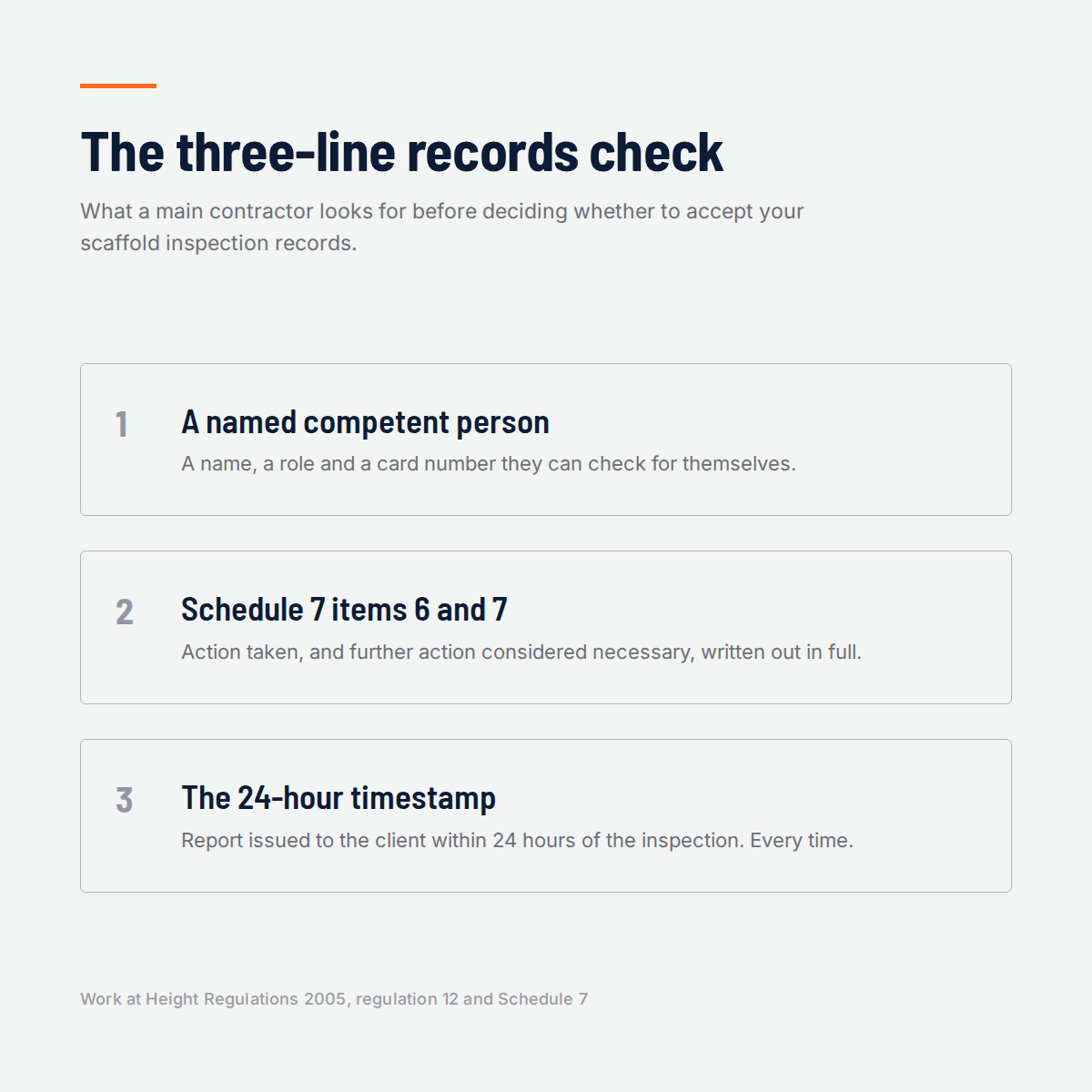
| What they check | What passes | What fails | |---|---|---| | A named competent person | A name, a role, and a qualification they can verify. A CISRS card number they can check | "Site supervisor" with no name, or a name with no evidence of competence | | Schedule 7 items 6 and 7 | Details of any action taken, and details of any further action considered necessary, written out | A defect list with no record of what was done about it | | The 24-hour timestamp | Report dated and issued to the client within 24 hours of the inspection, every time | Reports written up in a batch on Friday afternoon |
Those three come straight from the Work at Height Regulations 2005. Regulation 12 requires the inspection, Schedule 7 lists the eight particulars a report must contain, and regulation 12(7) sets the 24-hour rule. Items 6 and 7 of Schedule 7 are the ones that catch people out, because a tick-sheet with a column of ticks and one "loose board, bay 4" is a list of defects, not a compliant report.
The misconception to clear up: a scaffold tag is not an inspection report. The tag tells people on site whether the scaffold is in service. The Schedule 7 report is the legal record. Plenty of firms show a main contractor a wall of green tags and are surprised when the answer is "and where are the reports?"

I have set out all eight particulars, and the five additions that make a report worth reading, in a separate piece on what a scaffold inspection report must include.
Can my own scaffolder do the inspection?
Yes, legally, if they are competent for the type of scaffold, and I have written separately about what competent actually means. This article is not about whether you are allowed. It is about whether the main contractor will accept it.
Increasingly, on anything above a basic structure, they will not, for a practical reason rather than a legal one. Your inspector reports to you. Your programme suffers if the scaffold comes out of service. The main contractor knows that, and so does their insurer.
There is also a capacity point that firms underestimate. On the statutory seven-day cycle, a firm with eight live scaffolds is doing eight inspections a week, and each one needs a compliant report issued within 24 hours. If your carded man is also running a gang, that is a day a week he is not erecting, and he is the one person whose card you cannot afford to lose. When he goes on holiday, or leaves, your inspection regime goes with him.
The three ways to respond
Option one: prove your in-house regime meets the standard. If you have a named CISRS inspector, your reports carry all eight Schedule 7 particulars including items 6 and 7, and they go out within 24 hours, send four consecutive weeks of reports and a copy of the inspector's card. Some main contractors will accept that. The good ones will still want independence on high-consequence scaffolds: occupied buildings, public highway, anything designed rather than TG20-compliant.
Option two: bring in an independent inspector. This is the answer most firms end up at, and it is less painful than it sounds. The independent inspector works the seven-day cycle on your scaffolds, issues Schedule 7 reports within 24 hours in their own name, and your carded scaffolder goes back to erecting. The main contractor gets a record from a third party. You get to say yes to the job.
Option three: lose the job. Usually by not answering the question for a fortnight while you work out what to do. I have watched this happen. The main contractor does not withdraw the work dramatically, they just give the next one to someone who could show them the paperwork.
What independent inspection costs a scaffolding firm
The cost is per scaffold per week while it is standing. The value is the job you keep, plus the day a week your best scaffolder gets back.
Put it against the contract. If the main contractor's job runs for six months, that is 26 inspections on a single scaffold, and on most jobs that sits as a small fraction of the scaffold value, let alone the contract value. Firms that price it as a line item on the tender rather than an overhead stop feeling it almost immediately.
The other thing you buy is continuity. An independent inspector does not go on holiday from your scaffolds in the same way an employee does, because covering the cycle is the service.
What to send the main contractor this week
- A reply, within a day. Silence is what loses the job.
- Your inspector's name, role and card number, whether in-house or independent.
- The last four Schedule 7 reports for the scaffold in question, with items 6 and 7 filled in.
- If you are moving to independent inspection, say so and name the inspector. Contracts managers like a decision.
Key takeaways
- Main contractors ask because CDM 2015 regulation 13(1) makes them responsible for monitoring, and their audits want site-specific evidence. The driver is their file, which is easier to satisfy than it looks.
- They check three things: a named competent person they can verify, Schedule 7 items 6 and 7 filled in, and a report issued within 24 hours.
- A scaffold tag is not an inspection report. The Schedule 7 report is the legal record.
- In-house inspection is legal. Whether it is accepted depends on the scaffold and the contractor.
- Answer within a day. Most of these jobs are lost to silence, not to a bad scaffold.
Can a main contractor insist on independent scaffold inspections?
Yes. There is no law forcing independence, but the principal contractor sets the site rules and holds the duty to monitor under CDM 2015. If they make independent inspection a condition of the contract, that is a commercial term you either meet or decline. Most treat it as a contract condition rather than a legal one.
What must a scaffold inspection report contain?
Schedule 7 of the Work at Height Regulations 2005 lists eight particulars: who it was for, location, description, date and time, any risk identified, action taken, further action needed, and the inspector's name and position. Items six and seven are the ones most in-house tick-sheets leave blank.
Does an independent inspection replace our own checks?
No. The weekly independent inspection discharges regulation 12. Your gang still does the pre-use checks under regulation 13, and the site still calls the inspector if something hits the scaffold. Independence adds a record from outside the firm. It does not remove anyone's duty on site.
How quickly can an independent inspector start?
Usually within the week for a firm in Surrey, London or the South East, because the first visit only needs the scaffold's location, the design or TG20 compliance sheet if there is one, and a contact on site. The seven-day cycle then runs from that first inspection.
Need your scaffolds inspected independently?
I inspect scaffolds for scaffolding contractors across Surrey, London and the South East on the statutory seven-day cycle, with a Schedule 7 report in your inbox within 24 hours and my name and CISRS number on every one. If a main contractor has asked you for independent records, book the first inspection and I will have the paperwork with you before their next site meeting.

Jamie Will
CISRS Advanced Scaffolder with Advanced Scaffold Inspection and Temporary Works Coordinator. Founder of Will B Safe, carrying out independent scaffold inspections and testing across London and the South East.
More about Jamie