
Who is responsible for scaffold inspections on site: the scaffolder or the principal contractor?
CISRS Advanced Scaffolder with Advanced Scaffold Inspection, Temporary Works Coordinator | Reviewed October 2026

Quick answer
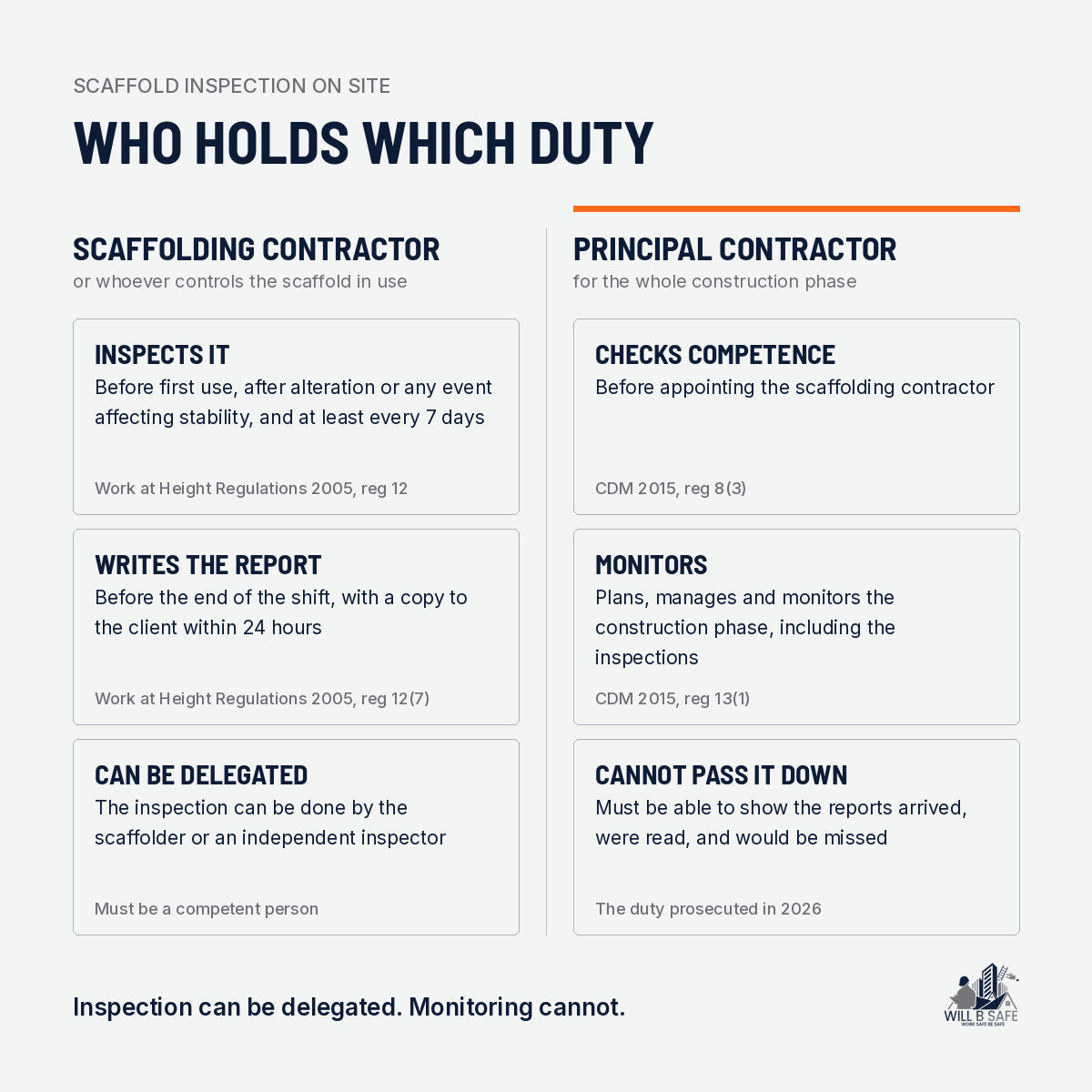
Both hold duties, but the principal contractor cannot pass theirs down the chain. The scaffolding contractor inspects what they erect under the Work at Height Regulations 2005. The principal contractor must plan, manage and monitor the whole construction phase under CDM 2015 regulation 13(1), and it is the principal contractor who was prosecuted in 2026 when weekly inspections on a London site stopped.
Most project managers I meet assume scaffold inspection belongs to the scaffolding sub. They erected it, they tag it, they inspect it. Job done.
Then something goes wrong, and the first question the HSE inspector asks is not "who erected this?" It is "show me the last four weekly inspection reports." If they are missing, the name on the prosecution is very often the principal contractor's.
This is not a theoretical risk. Here is who holds what, and what it costs when the records are not there.
Part of our scaffold safety guide.
What the law puts on each party
| Duty | Who holds it | Where it comes from |
|---|---|---|
| Inspect the scaffold before first use, after alteration or events, and at least every 7 days | The employer whose work equipment it is, in practice the scaffolding contractor while erecting and whoever controls it in use | Work at Height Regulations 2005, regulation 12 |
| Prepare a Schedule 7 report before the end of the working period, with a copy to the duty holder within 24 hours | The person who carried out the inspection | WAHR 2005, regulation 12(7) |
| Keep the report on site until the work is complete, then at an office for 3 months | The employer who receives the report | WAHR 2005, regulation 12(8) |
| Check the scaffolding contractor is competent before appointing them | Whoever makes the appointment, usually the principal contractor | CDM 2015, regulation 8(3) |
| Plan, manage and monitor the construction phase so work is done without risk, so far as reasonably practicable | The principal contractor | CDM 2015, regulation 13(1) |
| Pre-use check before each use | Whoever uses the scaffold | WAHR 2005, regulation 13 |
The word that matters in that table is monitor. Regulation 13(1) says the principal contractor "must plan, manage and monitor the construction phase and coordinate matters relating to health and safety". That is a continuing duty for the life of the site. Appointing a competent scaffolder discharges regulation 8(3). It does not discharge regulation 13(1). You still have to know the inspections are happening, and be able to show it.
What happened when the inspections stopped
In June 2026 a principal contractor was fined £50,000 and ordered to pay £11,347 in costs at Westminster Magistrates' Court after a worker fell through an unglazed window void from an external scaffold at a redevelopment site in New Malden, south west London, in July 2022. He died from his injuries.
The HSE's investigation found that the legally required weekly scaffold inspections had not been carried out after 5 July 2022. In the HSE's own words, the opportunity to identify the risk from the unglazed voids "by a competent scaffolding inspector was lost". The company was prosecuted under regulation 13(1) of CDM 2015, the monitoring duty. The HSE press release has the full account.
Two things to take from that.
The charge was not "you erected a bad scaffold". It was "you failed to monitor". The principal contractor's own duty, prosecuted in the principal contractor's own name.
And the gap was three weeks. Not a site with no inspection regime. A site where the regime existed and then quietly stopped, and nobody on the principal contractor's side noticed because nobody was looking for the reports.
How missing records change the fine
The Sentencing Council guideline for health and safety offences by organisations sets the fine from two things: culpability and harm, adjusted for turnover. Missing inspection records push culpability up, because the guideline lists "failing to put in place measures that are recognised standards in the industry" and "allowing breaches to subsist over a long period of time" as markers of high culpability. A weekly inspection is as recognised a standard as this industry has.
Here is what that movement does to the starting point, using the guideline's own figures:
| Organisation | Culpability | Harm category | Starting point |
|---|---|---|---|
| Micro (turnover up to £2m) | Medium | 3 | £14,000 |
| Micro (turnover up to £2m) | High | 3 | £30,000 |
| Small (turnover £2m to £10m) | Medium | 2 | £54,000 |
| Small (turnover £2m to £10m) | High | 2 | £100,000 |
Same incident, same harm. The difference between the two rows in each pair is whether you can show the inspections happened. For a small contractor that is £46,000 on the starting point alone, before costs, before the civil claim, and before the range, which for a small organisation at high culpability runs to £450,000.
Directors should also know the liability does not stop at the company. In a separate London case sentenced this summer, a firm was fined under regulation 19(2)(a) of CDM 2015 after a sheeted tower scaffold blew over on a busy high street and injured two members of the public, and its director was sentenced personally under section 37 of the Health and Safety at Work etc. Act 1974. The HSE press release sets it out.
"But our scaffolder has a competent inspector"
Good. Regulation 8(3) is satisfied. Regulation 13(1) is not, until you can show you monitored.
In practice that means three things on the principal contractor's side:
- You have seen the inspector's evidence of competence and kept a copy. A CISRS card number you have checked, not a verbal assurance.
- The reports reach you, within the 24 hours the regulations allow, and someone reads them. A report in the scaffolder's van is not monitoring.
- You would notice if they stopped. The New Malden gap was three weeks. Ask yourself honestly how many weeks a missing report would go unnoticed on your site right now.

The misconception worth clearing up here: a green scaffold tag on the ladder access is not an inspection report and does not evidence monitoring. It tells people the scaffold is in service. The Schedule 7 report is the legal record, and it is the report the HSE will ask for. I have set out exactly what it has to contain in what a scaffold inspection report must include.
When independent inspection is worth it for a principal contractor
Not every scaffold needs a third party. A short-duration, TG20-compliant scaffold on a closed site, inspected by the scaffolder's own carded man with reports landing in your inbox, is a monitored scaffold.
Where I would bring in an independent inspector, and where the principal contractors I work with do:
- Occupied buildings and public highway. The consequence of a failure is public, and the record needs to be beyond challenge.
- Designed scaffolds rather than TG20-compliant ones. Complexity raises the competence bar, and HSE is explicit that a basic-level inspector is not enough for complex structures.
- Long-duration scaffolds, where familiarity breeds missed defects and a regime is most likely to drift.
- Anywhere the scaffolder's paperwork has already been found wanting. If you have had one conversation about missing reports, you do not want a second.
An independent inspector reports to you, not to the scaffolder. That is the whole point. The reports arrive within 24 hours in the inspector's own name, and your regulation 13(1) monitoring file writes itself.
Key takeaways
- The scaffolding contractor inspects under WAHR 2005 regulation 12. The principal contractor monitors under CDM 2015 regulation 13(1). The second duty cannot be subcontracted away.
- A principal contractor was fined £50,000 plus costs in June 2026 under regulation 13(1) when weekly inspections on a New Malden site stopped for three weeks.
- Missing inspection records move culpability from medium to high, which for a small contractor lifts the sentencing starting point from £54,000 to £100,000.
- Directors can be sentenced personally under section 37 of the Health and Safety at Work etc. Act 1974, alongside the company.
- A scaffold tag is not a report and does not evidence monitoring.
- On occupied buildings, public highway, designed scaffolds and long-duration jobs, an independent inspector reporting directly to you is the cleanest evidence of monitoring there is.
Can a principal contractor delegate scaffold inspection responsibility to the scaffolding subcontractor?
The inspection itself, yes. The duty to monitor, no. CDM 2015 regulation 13(1) sits with the principal contractor for the whole construction phase. You can appoint a competent scaffolder to inspect, but you must be able to show that you knew the inspections were happening and read the reports.
How often must scaffolding be inspected on a construction site?
Before first use, after any substantial alteration, after any event likely to affect its stability such as high winds or impact, and at intervals of no more than seven days. This applies to any working platform from which a person could fall two metres or more. The full detail is in how often scaffolding needs to be inspected.
What should a principal contractor keep on file for scaffold inspections?
Evidence of the inspector's competence, such as a checked CISRS card number. Every Schedule 7 report, received within 24 hours of each inspection, kept on site until the work finishes and then at an office for three months. A note of who reviews the reports and when. That file is your regulation 13(1) evidence.
Was the New Malden prosecution about the scaffold being unsafe?
No. The charge was a failure to monitor under CDM 2015 regulation 13(1). The HSE found that weekly inspections had stopped three weeks before the fall, so the risk from the unglazed voids was never identified by a competent scaffold inspector. The absence of inspection was the offence.
Can a director be prosecuted personally over a scaffold?
Yes. Section 37 of the Health and Safety at Work etc. Act 1974 allows an individual director, manager or officer to be prosecuted where an offence by the company was committed with their consent or connivance, or was attributable to their neglect. Directors have been sentenced alongside their companies in scaffold cases this year.
Want a monitoring file that stands up?
I inspect scaffolds for principal and main contractors across London and the South East on the seven-day cycle, reporting directly to your site team with a Schedule 7 report within 24 hours. If you would rather know your regulation 13(1) file is complete than find out it is not, talk to me about independent inspection on your next site.

Jamie Will is the founder of Will B Safe, an independent scaffold safety consultancy working with scaffolding companies, contractors and councils across London and the South East. A CISRS Advanced Scaffolder with the Advanced Scaffold Inspection endorsement and a CITB Temporary Works Coordinator, he has spent over 20 years in the scaffolding industry and writes from the scaffolds he inspects and tests every week, not from theory.