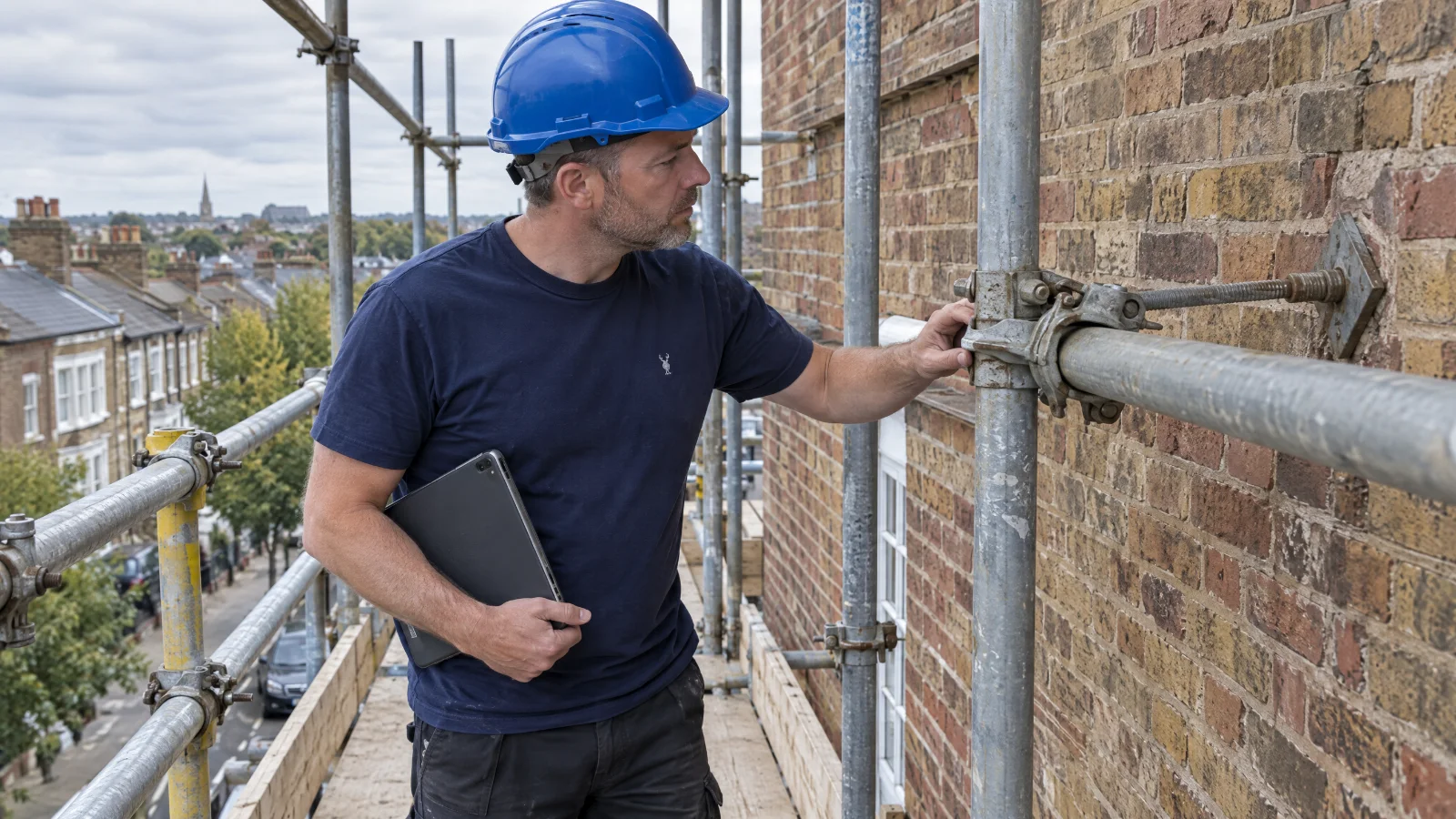
How often does scaffolding need to be inspected?
CISRS Advanced Scaffolder with Advanced Scaffold Inspection, Temporary Works Coordinator | Reviewed October 2026
Quick answer
Scaffolding must be inspected by a competent person before it is used for the first time, after any substantial alteration, after any event likely to have affected its stability, and at intervals of no more than seven days. Regulation 12 and Schedule 7 of the Work at Height Regulations 2005 set the rule. The seven days run from the last inspection, not from Monday, and every unscheduled trigger resets the clock.
A principal contractor asks for the last four inspection reports on a scaffold. Three are there. The fourth is nine days old.
The scaffold was fine. The paperwork was not, and the paperwork is what gets asked for. I see this gap more than any other, and it almost never comes from anyone cutting corners. It comes from nobody being sure exactly when the clock started, and nobody owning the diary.
This article sets out what the law actually requires, the four things that trigger an inspection, what resets the seven days, and what happens to the report afterwards. If you want someone else to own the diary, that is what my independent scaffold inspections are for, and I come back to that at the end.
Part of our scaffold safety guide.
What the law actually says
The requirement sits in regulation 12 of the Work at Height Regulations 2005, with the report contents in Schedule 7. The parts that matter on a scaffold:
- A working platform used for construction work, from which a person could fall 2 metres or more, must not be used unless it has been inspected in that position within the previous seven days (regulation 12(4)).
- Where the safety of the equipment depends on how it has been installed or assembled, it must be inspected after installation and before use (regulation 12(2)). Re-assembling part of a scaffold puts it back inside that rule.
- Equipment exposed to conditions that could cause deterioration liable to result in a dangerous situation must be inspected after any exceptional circumstances liable to jeopardise its safety (regulation 12(3)).
- An inspection means a visual or more rigorous check by a competent person, as appropriate for safety (regulation 12(10)). I cover who counts as competent in what is a competent person for scaffold inspection.
- The inspector must prepare a report before the end of the working period in which the inspection is completed, and give a copy to the person it was carried out for within 24 hours (regulation 12(7)).
The HSE's scaffolding guidance puts the same rules in plainer words: following installation and before first use, at an interval of no more than every seven days, and following any circumstances liable to jeopardise the safety of the installation, high winds being the example it gives.
What triggers an inspection, and what resets the clock
Four things trigger an inspection. Only one of them is in anyone's diary.
| Trigger | When it applies | Resets the 7 days? | The common mistake |
|---|---|---|---|
| Before first use | After erection and handover, before anyone works from it | Yes, the clock starts here | Trades go up before the handover inspection is done |
| After substantial alteration | Lifts added or removed, ties taken out, part dismantled, loading changed | Yes | Ties removed for window installation and nobody books a re-inspection |
| After an event likely to affect stability | High winds, vehicle impact, ground movement, flooding, anything exceptional | Yes | The scaffold looks fine from the ground, so the seven-day cycle carries on as if nothing happened |
| Every 7 days | At intervals of no more than seven days from the last inspection | Yes, each one starts the next seven | Counting from Monday, or counting working days |
The reset rule is the bit people miss. The seven days run from the last inspection, whatever triggered it. A scaffold inspected on a Tuesday, re-inspected on Thursday after a storm, is next due the following Thursday, not the following Tuesday. And it is seven calendar days. A bank holiday weekend does not pause the clock.
When is an event "likely to affect stability"?
The regulation leaves this to judgement, which is deliberate. Across Surrey, London and the South East the events that should prompt a call are predictable:
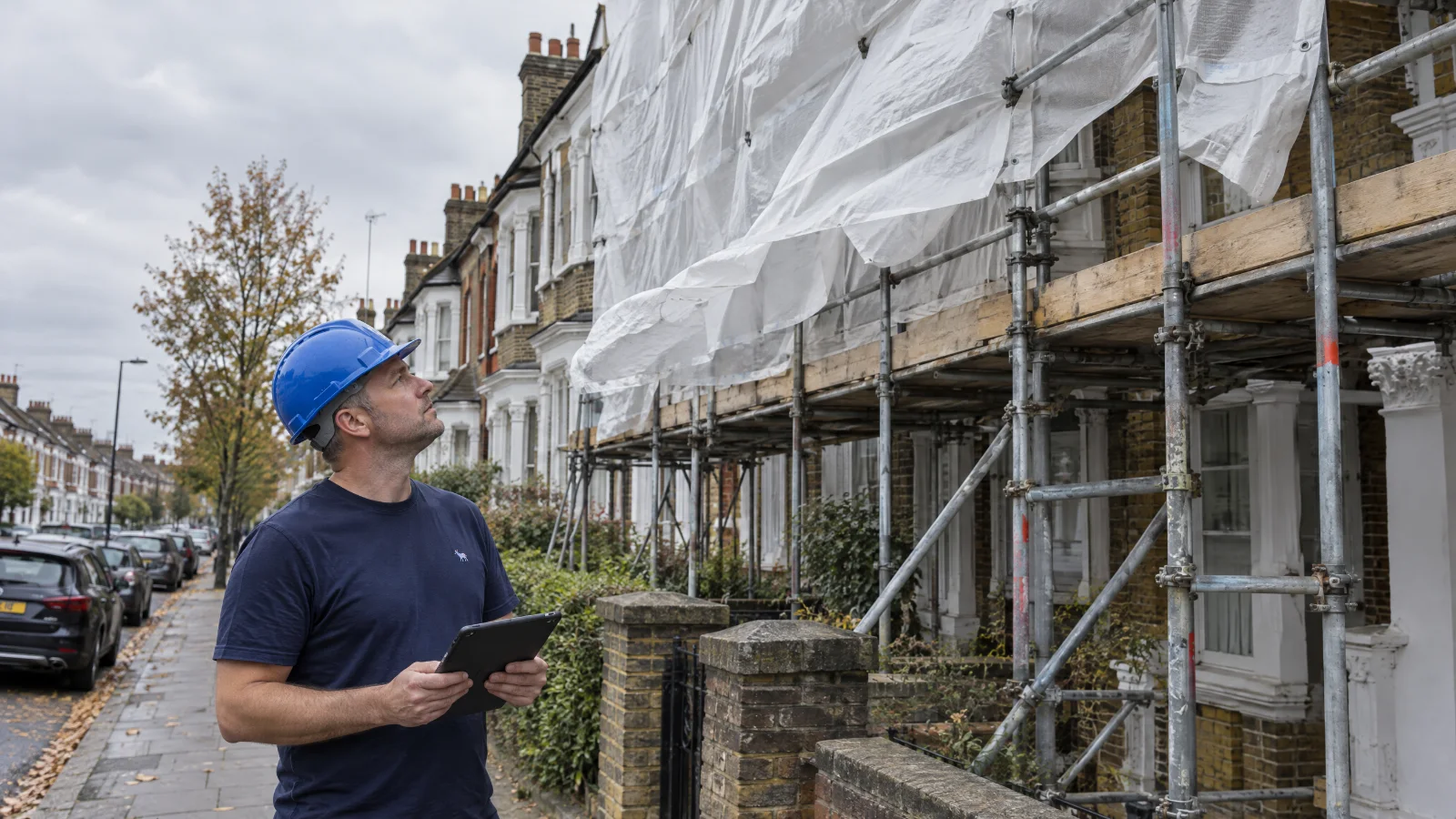
- High winds, especially on a sheeted or netted scaffold. Sheeting turns a scaffold into a sail. If the Met Office has issued a wind warning for your area, the scaffold needs looking at afterwards, whether or not anything is visibly wrong.
- Vehicle or plant strike. A delivery lorry clipping a standard at ground level can move a tie three lifts up.
- Ground movement. Made ground, trench excavations next to the base, heavy rain on a soft base, and anything that could have moved a sole board.
- Ties removed for the work. Window installation, render, cladding and brickwork repairs all involve taking ties out. This is an alteration as well as an event, and it is the single most common thing I find.
- Anything that would make you say "I wonder if that's all right". If the question has occurred to you, the inspection is the answer.
If in doubt, inspect. An unnecessary inspection costs an hour. A missed one costs the record.
What happens to the report afterwards
The report has to exist before the end of the working period in which the inspection was completed, and be with the person it was carried out for within 24 hours. I write mine on site and send them the same day, because a report written from memory three days later is a weaker document and everyone knows it.
Then it has to survive. Regulation 12(8) requires the report to be kept at the site until the construction work is completed, and after that at an office for three months. The retention rule is the one most firms get wrong, usually because the reports live in a site cabin that gets cleared when the job finishes. A shared folder that the site manager, the scaffolding contractor and the principal contractor can all see answers the retention question and the "where is last week's report" question in one go. What the report itself must contain is in my scaffold inspection report checklist.
A ninety-second check you can do today. Pull the last four inspection reports for one live scaffold and look at the dates. If any two are more than seven days apart, you have found your gap. If you cannot find four, you have found a bigger one. I set up weekly rounds for exactly this reason, and I am happy to look at what you have before you decide whether you need me.
What the seven-day cycle costs you
A scaffold that stands for twelve weeks needs at least twelve inspections, plus one before first use and one after every alteration or event. On a typical refurbishment that is fifteen to twenty inspections, each with a written report, from someone competent enough to sign it.
Done in-house that is an advanced scaffolder off the tools for a morning every week. Done as a one-off call-out each time, it is expensive. Done as a fixed weekly round, with several scaffolds close together on the same visit, it is the cheapest of the three, which is why most of my work is weekly rounds across Surrey, London, Kent and Sussex.
When you do not need to call anyone
Two honest limits.
In-house inspection is legal. If your firm has a competent person, the inspections happen every seven days without fail, and the reports would satisfy a stranger reading them months later, you do not need me. The case for an independent inspector is about the weight of the record when a principal contractor, an insurer or the HSE asks for it, not about legality. I set that out properly in who is responsible for scaffold inspections on site.
And a weekly inspection does not replace daily awareness. The regulations put a pre-use check on the people using the scaffold. Someone on site should be looking at the scaffold every morning. That is not something to buy in.
Key takeaways
- Four triggers: before first use, after substantial alteration, after any event likely to affect stability, and at intervals of no more than seven days.
- The seven days run from the last inspection, whatever triggered it, and every unscheduled inspection resets the clock. Calendar days, not working days.
- The rule applies to any working platform used for construction work from which a person could fall 2 metres or more.
- The report must exist before the end of the working period, reach the duty holder within 24 hours, stay on site until the work finishes, and then be kept for three months.
- If you are wondering whether an event affected the scaffold, that is the trigger. Inspect.
How often does scaffolding legally need to be inspected in the UK?
At intervals of no more than seven days, plus before first use, after any substantial alteration and after any event likely to have affected its stability. The requirement is in regulation 12 of the Work at Height Regulations 2005 and applies to working platforms from which a person could fall 2 metres or more.
Is the seven-day scaffold inspection seven working days?
No. Seven calendar days from the last inspection. A scaffold inspected on a Tuesday is due again by the following Tuesday, and a bank holiday weekend does not extend it. Any inspection after an alteration or an event restarts the seven days from that date.
Does a scaffold need re-inspecting after high winds?
Yes. High winds are the example the HSE's own guidance gives of circumstances liable to jeopardise the safety of a scaffold, and a sheeted or netted scaffold is affected most. The re-inspection resets the seven-day clock.
How long do scaffold inspection reports need to be kept?
On site until the construction work is completed, then at an office for three months after that. Regulation 12(8) of the Work at Height Regulations 2005 sets this out. A shared digital folder is the simplest way to meet it.
Can a scaffolding company inspect its own scaffolds?
Yes, provided the person is competent for the type and complexity of the scaffold. In-house inspection is legal and works when done properly. An independent report carries more weight when a principal contractor, insurer or the HSE asks for it, which is the reason firms bring one in.
Want the seven-day cycle off your desk?
I run weekly inspection rounds across Surrey, London and the South East. Same scaffold, same day, every week, with the Schedule 7 report and photos in your inbox within 24 hours and defects carried forward until they are closed. If you would rather know the dates line up than hope they do, get your scaffolds on a weekly round.
Speak to Jamie or call +44 7737 041470.

Jamie Will is the founder of Will B Safe, an independent scaffold safety consultancy working with scaffolding companies, contractors and councils across London and the South East. A CISRS Advanced Scaffolder with the Advanced Scaffold Inspection endorsement and a CITB Temporary Works Coordinator, he has spent over 20 years in the scaffolding industry and writes from the scaffolds he inspects and tests every week, not from theory.