Scaffold inspection report checklist: 13 things every report should contain
CISRS Advanced Scaffolder with Advanced Scaffold Inspection, Temporary Works Coordinator | Reviewed October 2026

Quick answer
A scaffold inspection report must record who it was prepared for, the location and description of the scaffold, the date and time, any matter that could give rise to a risk, any action taken, any further action needed, and the name and position of the inspector. That is the legal minimum under Schedule 7 of the Work at Height Regulations 2005. The most-missed item is a description that actually describes the scaffold.
A tick sheet with a signature and the word "OK" is legally arguable and practically useless.
It is arguable because Schedule 7 of the Work at Height Regulations 2005 asks for eight specific particulars, and "OK" is not one of them. It is useless because the whole point of the report is that someone who was never on site can understand the condition of the scaffold months later: a principal contractor's auditor, an insurer, or an HSE inspector after something has gone wrong.
Here are the eight things the law requires, the five things I add to every report because they decide whether it holds up, and a five-question audit you can run on your own reports this afternoon. If you would rather have the reports written for you, that is what my independent scaffold inspections deliver every week.
Part of our scaffold safety guide.
The eight particulars the law requires
Schedule 7 is short. Every report of an inspection under regulation 12 must contain these, and nothing else is mandatory.
| # | Schedule 7 particular | Why it is there | What a fail looks like |
|---|---|---|---|
| 1 | Name and address of the person for whom the inspection was carried out | Fixes who the duty holder is | Company name only, no site address, or left blank |
| 2 | Location of the work equipment inspected | Which scaffold, on which site, on which elevation | "Site" or "Main scaffold" on a job with four scaffolds |
| 3 | Description of the work equipment inspected | So a stranger can picture it | "The scaffold". The most-missed item on the list |
| 4 | Date and time of the inspection | Starts the seven-day clock | Date only, or a date that does not match the tag |
| 5 | Details of any matter identified that could give rise to a risk to health or safety | The findings | "None" on a scaffold that has a missing guardrail in the photos |
| 6 | Details of any action taken as a result | What was fixed on the day | Blank, even when something was obviously put right |
| 7 | Details of any further action considered necessary | What still needs doing, and by whom | "Monitor", which is not an action |
| 8 | Name and position of the person making the report | Who is accountable | An initial, or a signature nobody can read |
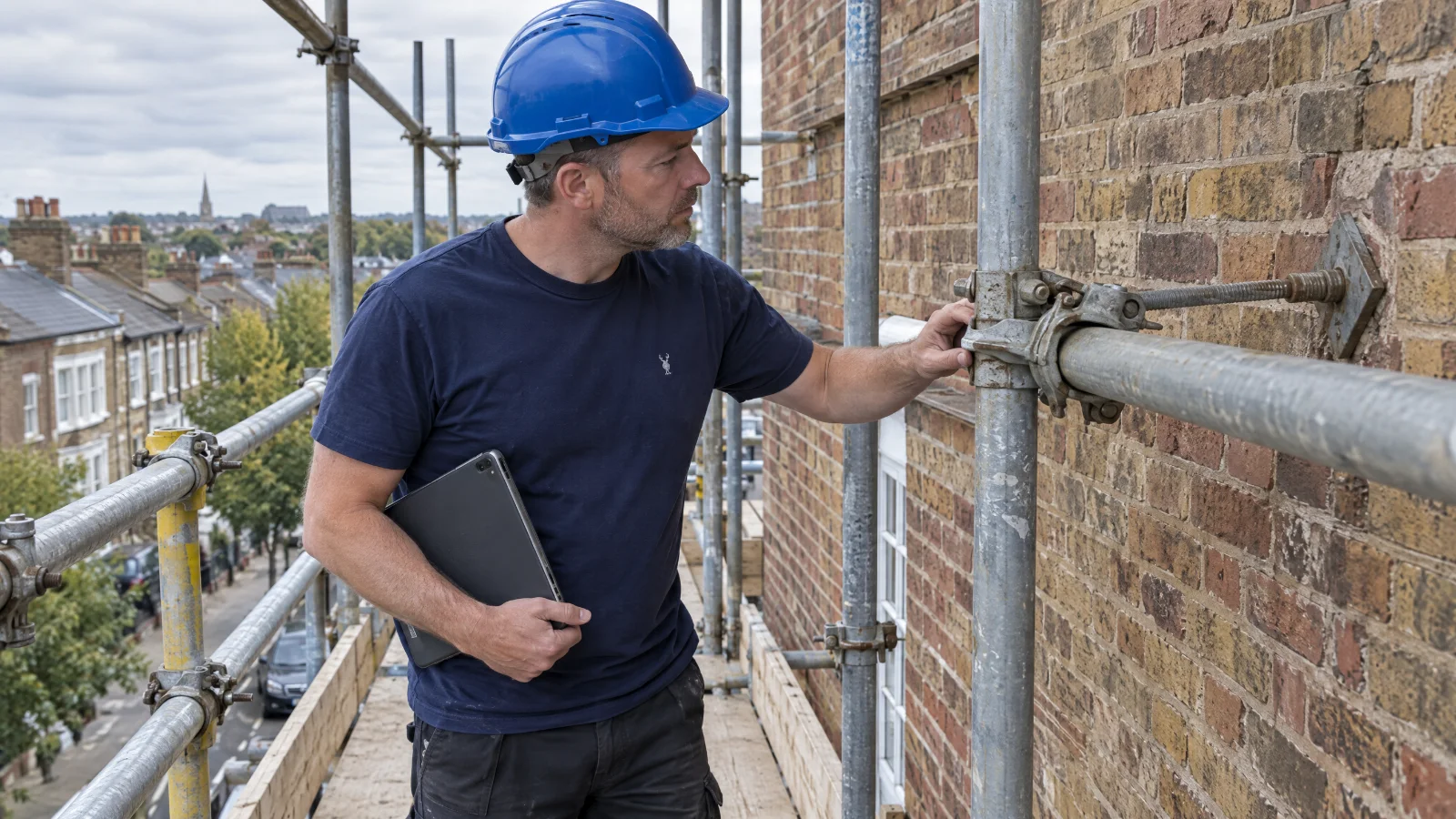
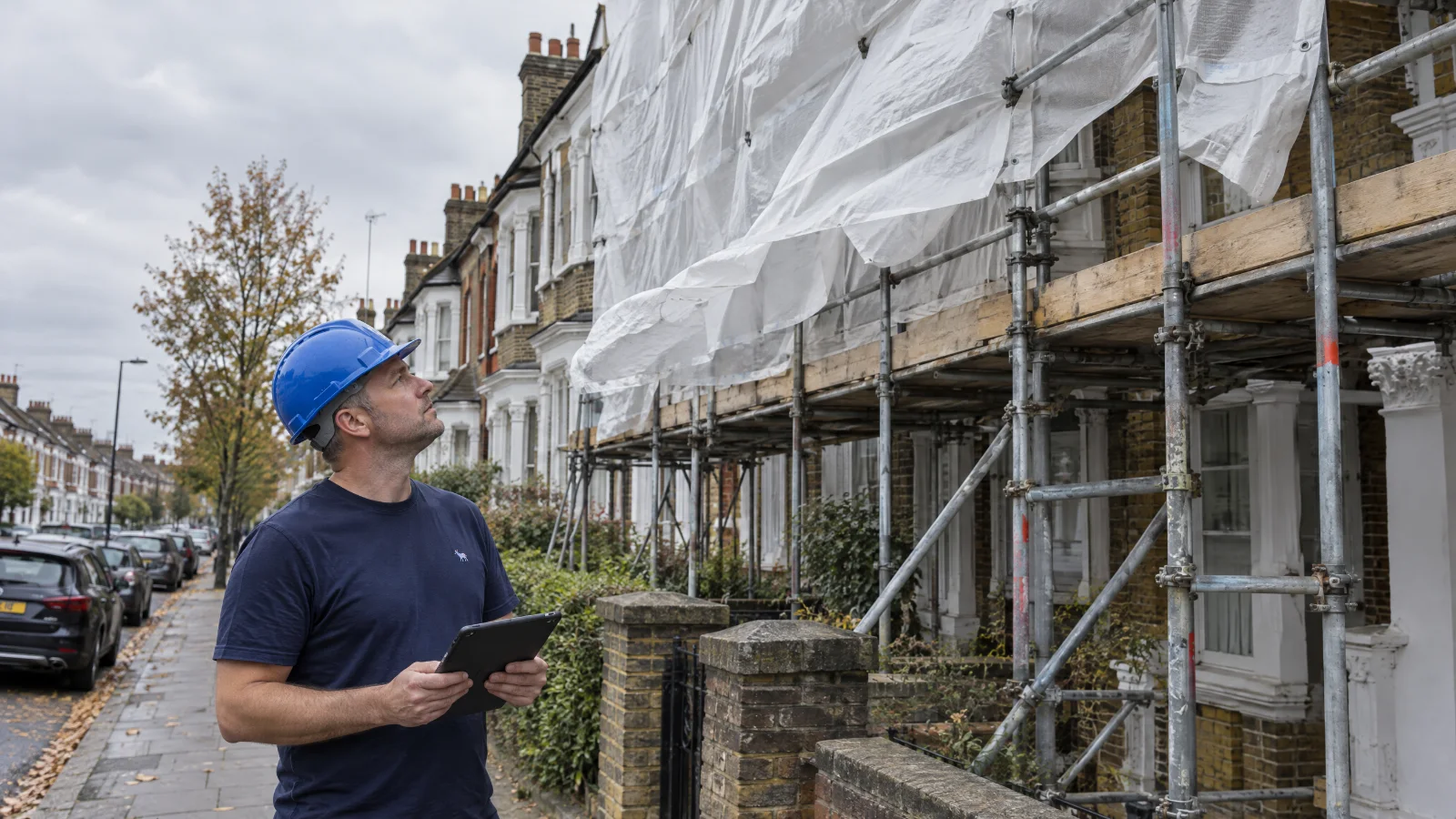
Item 3 is where most reports fall down. A description should say what kind of scaffold it is, how many lifts, roughly how long, what it is loaded for, whether it is sheeted or netted, how it is accessed and how it is tied. If the description could apply to any scaffold on any site, it is not a description.
The five additions that decide whether it holds up
None of these are required by Schedule 7. All of them are the difference between a report that satisfies the regulation and a report that does its job.
1. Captioned photographs. A photo without a caption is decoration. "Missing ledger brace, lift 3, east elevation, bay 4" is evidence. Every photo in my reports says what it shows and where it is, so the scaffolding contractor can walk straight to it.
2. A stated verdict. Safe to use, safe with the actions listed, or not to be used until rectified. A report that lists findings and never says which of those three applies has left the decision to whoever reads it, which is usually a site manager with no scaffolding background.
3. Defects carried forward. Anything open from the previous report stays on this one until it is closed. Without this, a defect reported in week two and never fixed disappears from the record in week three, and nobody notices until week nine.
4. A plain-English summary email. The report is the legal record. A short email listing the actions in priority order is what gets things fixed, because a site manager reads an email at half four on a Friday and does not open a PDF.
5. Traceability between the tag and the report. The date on the scafftag and the date on the report should match, and the report should say the tag was updated. When the tag says one thing and the paperwork says another, an auditor assumes the worse one is true.
The 24-hour rule, and why reports get written the same day
Regulation 12(7) requires the report to be prepared before the end of the working period in which the inspection was completed, and a copy to be with the person it was carried out for within 24 hours. That is the law, not best practice.
It also happens to produce better reports. A report written on the scaffold, with the photos taken as the findings are recorded, is specific. A report written from memory on Thursday evening about a scaffold inspected on Monday morning is generic, and it reads generic. If your reports are currently written up in batches at the end of the week, the write-up delay is itself a compliance risk, before you get to the contents. How the inspection timing works is in how often scaffolding needs to be inspected.
How long the report has to survive
Regulation 12(8): kept at the site until the construction work is completed, then at an office for three months. On a long job that means a report from month one has to be findable in month ten, then for a further three months after handover.
The system that works is dull. One shared folder per site, one PDF per inspection, named by scaffold and date, visible to the scaffolding contractor, the site manager and the principal contractor. When an insurer asks for the records, the answer takes thirty seconds. When the site cabin is cleared at the end of the job, nothing is lost.
What to do with your results: the five-question self-audit
Pull the last four inspection reports for one live scaffold. Read them as if you had never been to the site. Then answer these five questions.
- Could a stranger picture the scaffold from the description? If not, item 3 is failing, and it is the first thing an auditor notices.
- Are the four dates each seven days or fewer apart? If any gap is longer, the record has a hole in it whatever the scaffold was like.
- Does every finding say where it is? Lift, elevation, bay. "Guardrail missing" with no location is a finding nobody can act on.
- Does every report say whether the scaffold is safe to use? If you have to infer the verdict from the findings, the report has not given one.
- Can you see on the later reports whether the earlier defects were closed? If a defect appears once and vanishes, you cannot tell whether it was fixed or forgotten.
Five out of five, and your reports are doing their job. Three or fewer, and the paperwork is weaker than the scaffold. Most reports I am handed score two or three, and the firms involved are not careless. They are using a form that was designed to be quick rather than designed to be read.
When your own reports are fine
If your in-house reports pass all five questions, you do not need to pay anyone to write them. In-house inspection by a competent person is legal, and done like this it works. Who counts as competent is covered in what is a competent person for scaffold inspection.
The case for an independent report is about weight, not legality. When a principal contractor asks for records, and more of them are asking, a report signed by someone who did not erect the scaffold and does not work for the firm that did carries more weight than the same report signed in-house. What to do when that request lands is in a main contractor has asked for independent scaffold inspection records.
Key takeaways
- Schedule 7 requires eight particulars: who the inspection was for, the location, a description, the date and time, any risk identified, any action taken, any further action needed, and the inspector's name and position.
- The most-missed item is a description that actually describes the scaffold. "The scaffold" is not a description.
- Five additions decide whether the report holds up: captioned photos, a stated verdict, defects carried forward, a summary email, and a tag that matches the report.
- The report must be written before the end of the working period and reach the duty holder within 24 hours. Same-day reports are also better reports.
- Keep reports on site until the work finishes, then for three months. A shared folder per site answers an insurer in thirty seconds.
- Run the five-question audit on your last four reports. If they pass, keep doing what you are doing.
What is legally required in a scaffold inspection report?
The eight particulars in Schedule 7 of the Work at Height Regulations 2005: the name and address of the person the inspection was for, the location of the scaffold, a description of it, the date and time, any matter that could give rise to a risk, any action taken, any further action needed, and the name and position of the person making the report.
Do scaffold inspection reports need photographs?
The law does not require them. In practice a report with captioned photographs is far stronger evidence than one without, because a photo that says what it shows and where it is can be checked by someone who was never on site. I include them on every report.
Who signs a scaffold inspection report?
The competent person who carried out the inspection. Schedule 7 requires their name and position, not just a signature. The person who stood on the scaffold is the person who signs the report.
How quickly must a scaffold inspection report be issued?
It must be prepared before the end of the working period in which the inspection was completed, and a copy must reach the person it was carried out for within 24 hours. Regulation 12(7) of the Work at Height Regulations 2005 sets both limits.
Is a scafftag the same as an inspection report?
No. The tag tells people on site that the scaffold is in service and when it was last inspected. The Schedule 7 report is the legal record, and it is the report a principal contractor, insurer or the HSE will ask for. The two should always carry the same date.
Want reports that pass all five questions?
Every inspection I carry out comes with a Schedule 7 report, captioned photos, a stated verdict and defects carried forward week to week, in your inbox within 24 hours, with a summary email that tells the site manager what to fix. If your current reports would not survive a stranger reading them, talk to me about a weekly round.
Speak to Jamie or call +44 7737 041470.

Jamie Will is the founder of Will B Safe, an independent scaffold safety consultancy working with scaffolding companies, contractors and councils across London and the South East. A CISRS Advanced Scaffolder with the Advanced Scaffold Inspection endorsement and a CITB Temporary Works Coordinator, he has spent over 20 years in the scaffolding industry and writes from the scaffolds he inspects and tests every week, not from theory.